

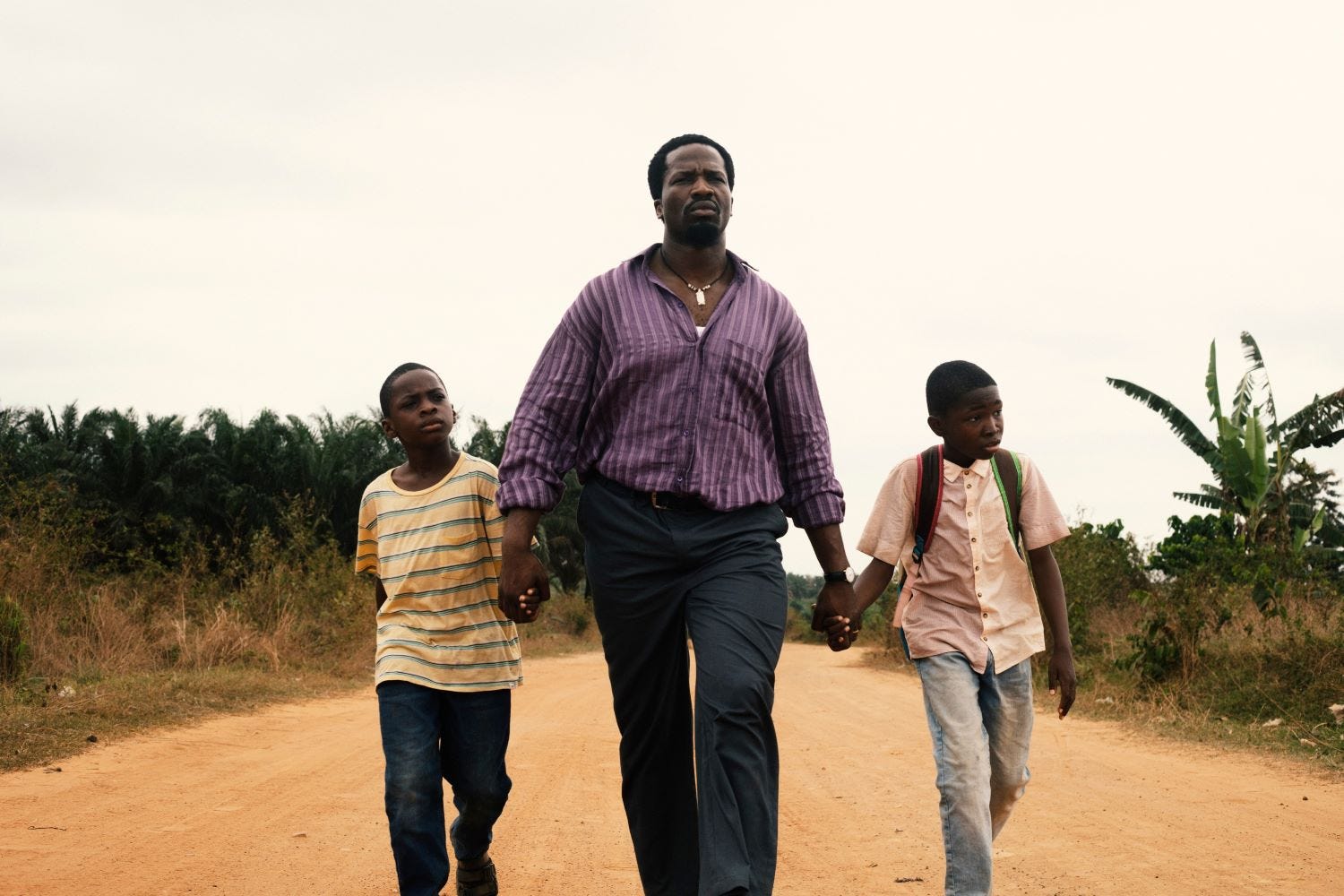
I genuinely loved My Father’s Shadow, as it’s the kind of film that doesn’t overwhelm you or try anything big, but instead it just settles in slowly into your head and stays with you.
Synopsis
Two young brothers explore Lagos with their estranged father during the 1993 Nigerian election crisis, witnessing both the city's magnitude and their father's daily struggles as political unrest threatens their journey home.
Good Points
Deeply immersive
Excellent performances
Emotional
Strong historical backdrop
Beautiful piano score
Bad Points
Occasional jarring transitions
Focus drifts slightly in places.
You feel like you are walking alongside Remi and Akin.
Damn, this movie is pretty immersive, where you feel like you are discovering Lagos alongside Remi and Akin as they move through Lagos, where everything is filtered through their perspective, with a childlike lens that gives even ordinary moments a sense of worth.
The city is a brilliant backdrop - the streets, the bridges, the lagoon, the people drifting in and out of frame, to the point you might even smell the air - OK, maybe not, but the setting here is inseparable from the characters.
The small moments are what make it powerful.
There’s no over-polishing here at work - the boys argue, joke, get irritated, and ask questions adults have stopped asking - and Remi carries that older-brother responsibility, trying to explain things he barely understands himself.
Akin’s curiosity though is relentless, sometimes awkward, and also sometimes funny.
I found the father fascinating more than anything though, as he’s charming and warm, but there’s an emotional gap you can really feel, and it’s as if he’s always running toward something - or away from something.
The moments where the boys begin to see him through other people’s eyes hit hard, as you can feel their understanding of him quietly shifting.
The dialogue is pretty simple too , but it comes across that every spoken word matters, even a little.
It isn’t all softness.
The film doesn’t shy away from the harshness either, with sudden flashes of violence that remind you that innocence has limits, and some scenes force you to sit with some uncomfortable truths about the world these kids are navigating, and setting the story on the day of Nigeria’s 1993 presidential election also adds a quiet but constant tension.
The pacing is patient
I’ll admit the rhythm probably won’t suit everyone, but it’s deliberate, where moments can stretch., but personally, I appreciated that patience because it mirrors how a day actually feels, but I can see some people finding it slow.
And a word on the score, as Duval Timothy’s and CJ Mirra’s piano adds another emotional layer to it all, where at times it feels like it is just floating gently, while at other times it hums with nervous energy.
This is a film that feels ever so human.
Final Verdict
My Father’s Shadow is absolutely worth watching, as it’s observant, tender, and quietly heartbreaking - and if you let yourself sink into its rhythm, it leaves a lasting impression.
More Reviews


