

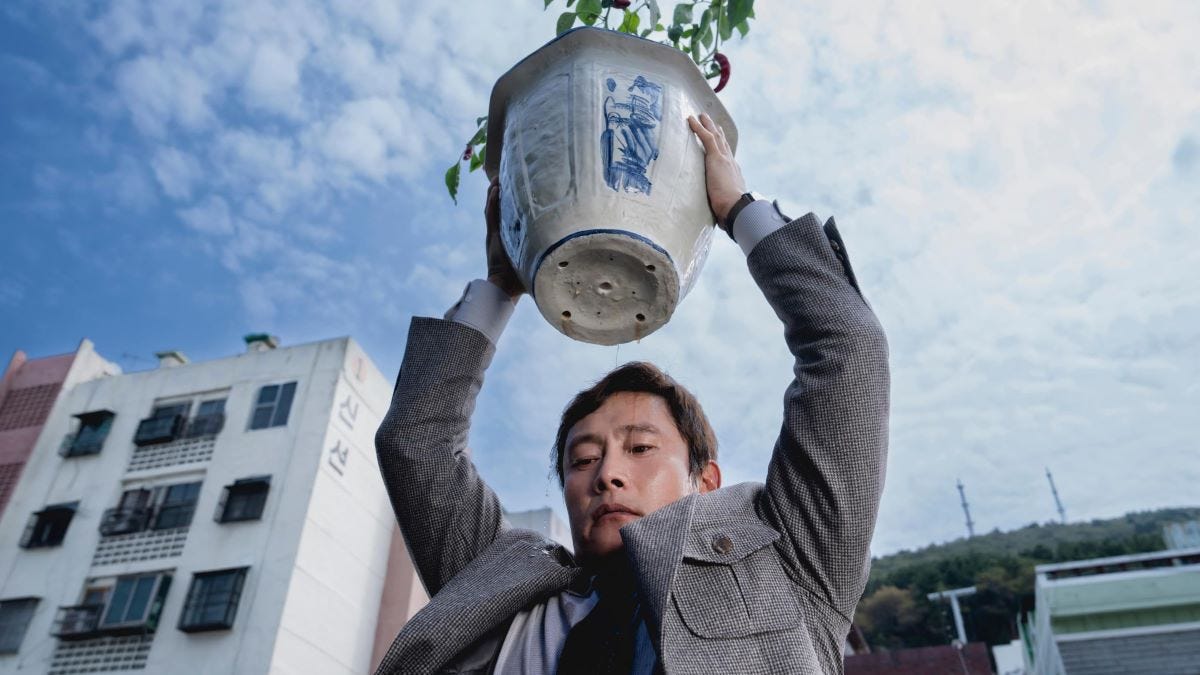
No Other Choice is a title that feels like a threat - it’s blunt, stubborn, and already tired of your questions.
In my head, that usually means one of two things - total control, or a willingness to burn everything down just to prove a point.
Thankfully, this movie knows exactly which one it wants to be.
Good Points
Commits hard to its premise and never blinks
Lee Byung-hun gives a quietly suffocating performance
Builds the tension through routine, and not spectacle
The dark humor makes you feel bad for laughing
Moral ambiguity is allowed to exist without any hand-holding
Bad Points
Later choices push some plausibility to its limits
Emotional distance grows as the film gets more extreme
It doesn’t circle its idea, it corners it
The film settles into Yoo Man-Su’s life without much ceremony - work, home, routine, repeat.
Everything depends on that loop continuing, and the movie is patient enough to let you feel how fragile that dependency really is, where you will probably find yourself watching the small stuff more than the plot, as nothing announces itself.
That’s the trap, though.
When the routine does break, the film doesn’t dramatize it, as losing his job isn’t a shock, it’s a logistical problem with emotional consequences, as bills still exist and pride doesn’t evaporate.
It’s just a slow slide, a series of compromises that feel reasonable until you realize how far you’ve gone, where making bad decisions actually feel logical.
Every choice makes sense, which is the real problem
Lee Byung-hun carries the film almost entirely with so much restraint. where everything sits under the surface, and where he’s constantly measuring himself against who he was, who he thinks he should be, and who he’s becoming.
Even when he’s technically in control, he looks like someone bracing for impact, and his facial expression tell you more than just explaining his psychology out loud.
His marriage adds another pressure point.
We get to see affection, frustration, loyalty, resentment - and sometimes all in the same scene, and no one here is framed as wrong or right, as they’re just reacting differently to the same stress.
Domestic tension as a slow-burn horror device
As things escalate, the dark humor starts creeping in, where you get to see the absurdity leaking through the cracks, where Ilaughed a few times and immediately felt suspicious of myself.
But the humor just sharpens everything with a full stop, and director Park Chan-wook has this precise sense of timing, letting irony surface just long enough to sting before cutting away.
Space is another element you will notice - long, static shots make spaces feel oppressive, while faster, messier sequences reflect how little control Man-su actually has.
Nothing feels decorative, and everything serves the pressure.
Eventually, the film does push Man-su so far that I felt myself pulling back emotionally a little bit, and while I understood the logic, the belief started to wobble, but that refusal to stay safe is part of the point I suppose.
And it’s a very minor quibble.
Cold, controlled, and not here to reassure you
Verdict
You have to respect the commitment of No Other Choice, as it’s tense, darkly funny, and emotionally unforgiving.
Worth watching if you’re okay sitting with discomfort and no easy exits.
Hell, it’s worth watching even more if you’re not okay with that.
More Reviews:


It's a fun ride for sure. I loved it.