Over Your Dead Body grabs a tone, drops it halfway, then sprints in a completely different direction and hopes you don’t notice the switch.
Plot
A dysfunctional married couple retreats to a secluded cabin to repair their relationship, but each secretly plots to murder the other.
Good Points
Sharp, mean-spirited humour early on
Jason Segel and Samara Weaving’s chemistry
Energetic supporting cas
A few genuinely funny, unexpected moments
Some clever setups and payoffs in the writing
Violence has some initial shock value and impact
Bad Points
Tone shifts too abruptly in the second half
Relies too heavily on violence as it goes on
Loses the sharp dialogue that made the first act work
Final stretch feels more like escalation for the sake of it
My Thoughts On Over Your Dead Body
It starts sharp, and then forgets why that worked
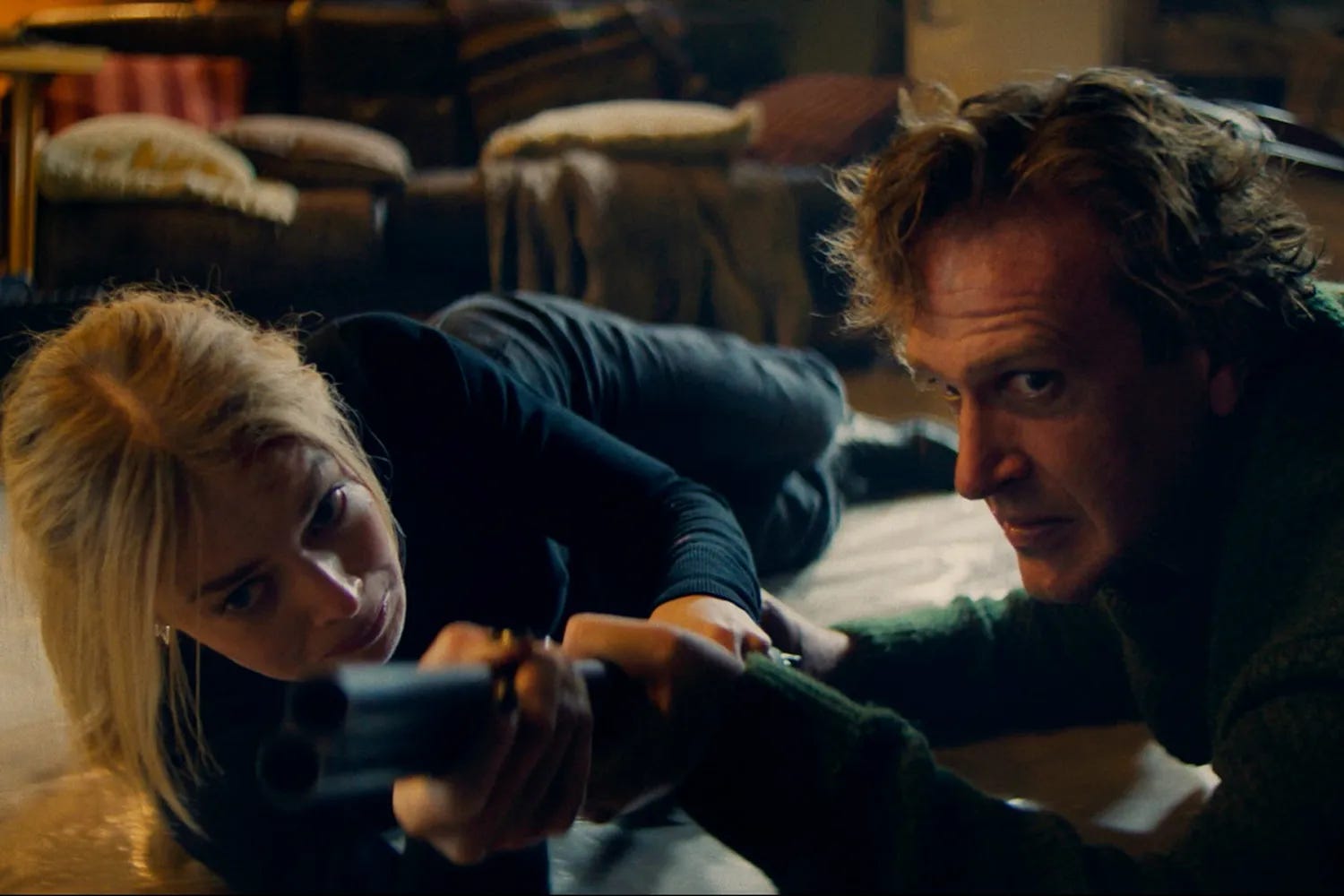
The opening is easily the strongest part of the film, and I loved the humour on show, which is biting, fast, and just uncomfortable enough to keep it interesting, and Jason Segel and Samara Weaving spend most of that first stretch tearing into each other with a kind of controlled rhythm to it, so, for a while, it looks like the film knows exactly what it’s doing.
Samara Weaving and Jason Segel
I do love Samara Weaving, and here her performance is very much a two-person engine early on with Jason Segel, who leans in hard into playing someone irritating and quite self-absorbed - sometimes it’s funny, but sometimes it crosses into just being a bit much - so there’s a thin line there, and he doesn’t always stay on the right side of it.
Samara Weaving on the other hand is sharper, more precise, and has a better handle on the tone, even when the script starts to wobble later, with a control to her performance that the rest of the film could’ve used more of.
The shift
Once the film expands beyond the central dynamic, everything changes, and just flips, with more characters entering the picture, so the focus moves away a bit from controlled dialogue into something more chaotic, and where what we had before turns into more of a situation where scenes just want to escalate as quickly as possible.
And while I wouldn’t say that shift is inherently bad, it is jarring, and it makes you feel like you’ve stepped into a slightly different film that just happens to share the same cast.
The supporting cast adds energy, but not depth
Timothy Olyphant slides in with that calm, slightly offbeat presence he always brings, and it works fine, because he doesn’t overdo it, which actually helps balance some of the louder elements.
Juliette Lewis goes the opposite way - more chaotic, more unpredictable - which fits the tone the film is aiming for in the second half, while Keith Jardine is a bit of a surprise, as he fits the physicality of the role very well and helps sell some of the more over-the-top moments.
But here’s the issue, none of these characters really go anywhere - they show up, add energy, serve their purpose, and that’s about it, so there’s no real development, no shift, and no deeper layer.
Violence takes over, and doesn’t know when to stop
This is where the film started to lose me a bit, as early on, the violence worked because it was unexpected, and it catches you off guard, adds to the humour, and pushes the tone into something darker without completely overwhelming it, but then it keeps going back to that same idea, so after a while, it stops being surprising.
It doesn’t enhance anything, but it just replaces what made it work in the first place - the sharp dialogue fades out, and the violence steps in to fill the gap - but it’s not as effective on its own.
There’s only so many times escalation works before it starts feeling repetitive, and what’s very frustrating is that the film already had something working - that early balance of mean humour, tight dialogue, strong performances - that was the hook.
And then it just drifts away from it, so by the second half, those quick, cutting exchanges are mostly gone, replaced by shouting, chaos, and physical conflict, and while there’s still energy, it has a lot less personality.
Also, oddly enough, one of the standout moments comes from a smaller role, where Paul Guilfoyle shows up briefly and immediately freshens it all up compared to everything else going on, and ends up bcoming a quick reminder that when the film focuses on character and interaction, it actually works really well.
There are also a few clever setups and callbacks scattered throughout that show some thought went into the writing, but just doesn’t build on them enough.
The ending tries to pull it back
By the final stretch, the film is running on momentum, where the humour has taken a back seat, the violence has done most of the work, and what’s left feels more like escalation for the sake of it rather than a natural progression - it does try to soften things though, which wasn’t a bad idea, but it all feels rushed, like the film suddenly remembered it needed to land somewhere, not just keep going, but despite these grievances, there’s still some fun to be had here, but it never quite holds onto what made it work in the first place.
Final Verdict
Strong start, some sharp humour, and a decent enough cast, but it just forgets what made it work in the first place - entertaining in bursts, but pretty uneven overall.
Trailer
Directed by - Jorma Taccone
Screenplay by - Nick Kocher and Brian McElhaney
Cast Includes - Jason Segel, Samara Weaving, Paul Guilfoyle, Keith Jardine, Timothy Olyphant, and Juliette Lewis.
Cinematography - Matt Weston
Running time - 105 minutes
More Movie Posts