

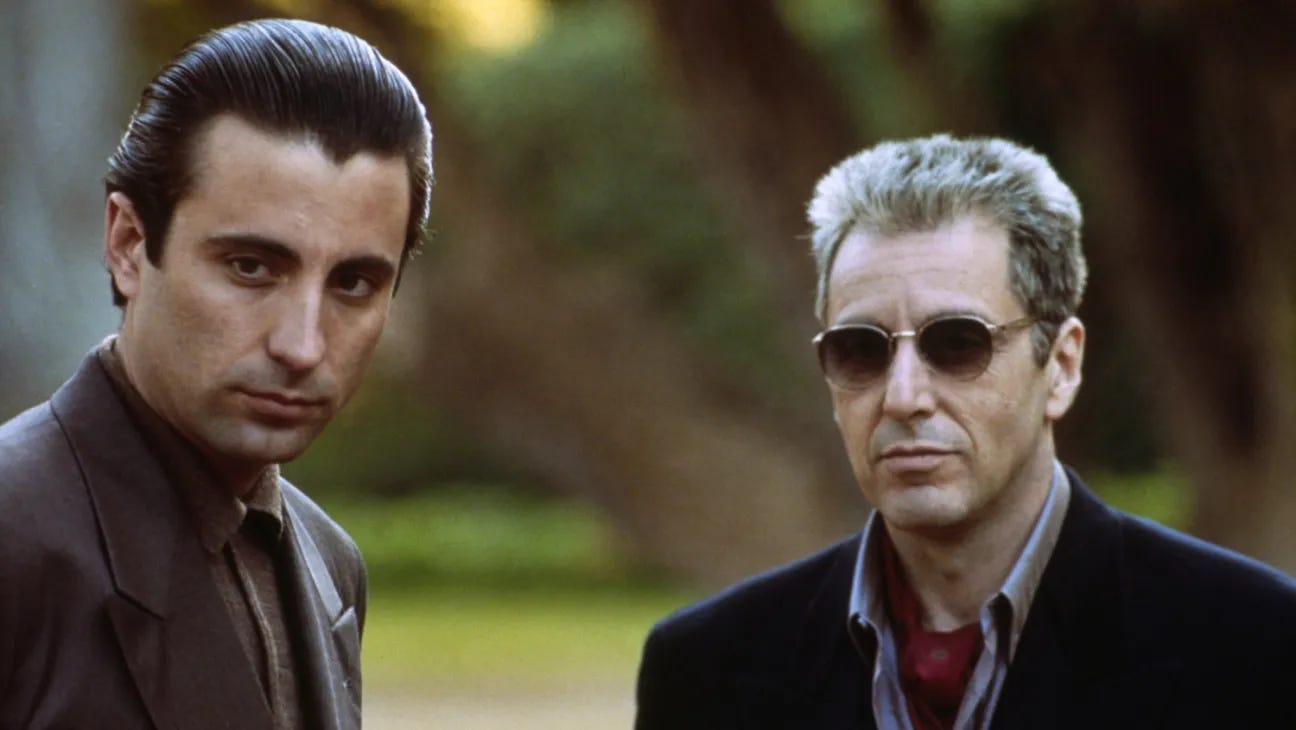
Some returns feel necessary, but this one feels negotiated - sixteen years is a long gap, and The Godfather Part III never lets you forget it.
After the genius of the first two movies, we get the 3rd, which a lot of Godfather fans don’t even like to talk about, because not only is it a bad Godfather movie, it’s also just a bad movie full stop.


Good Points
Al Pacino brings a more worn, human version of Michael
Strong scenes between Michael and Kay
Andy García
A few grounded, character-focused moments that actually work
Bad Points
Overcomplicated plot
Weakly developed supporting characters
The Vatican storyline
Tonal inconsistency
Sofia you know who.
Is it an ending or a continuation?
That’s the main issue I have with this movie, as it never really resolves, because the film is constantly pulling in two directions - part of it wants to close the story, strip things down, and focus on consequence, while the other part keeps expanding outward with new characters, new conflicts, and new layers of conspiracy.
It never chooses which way it truly wants to go.
Michael still works
This is where the film is strongest, as Al Pacino doesn’t play Michael the same way this time, and I don’t have a problem with that, because if anything, it makes sense.
He’s not the controlled, unreadable figure anymore, - there’s strain now, effort, where you can see the weight of everything sitting on him, and that shift in his character is the best part about the movie, and Al Pacino obviously plays it superbly, too.
The moments with Kay are where it all feels most really focused, where there’s history that doesn’t need explaining, and those scenes slow everything down in the correct way much like in the first two.
Unfortunately the rest of the film does not.
Vincent
I like Vincent, and Andy García is one of the few additions that actually works, and he isn’t just a copy of Michael either - he’s rougher, more impulsive, but not careless - and there’s at least some attempt to show conflict under the surface with him, and because of that he is somewhat interesting, where some of his scenes are the clearest in the film - they’re direct, easy to follow, and don’t get buried under layers of plot.
Which makes it more frustrating when the film complicates him unnecessarily, because the romance subplot doesn’t work., it’s distracting, and raises questions the film doesn’t bother answering, and pulls attention away from what already works.
The film gets louder, but not better.
The helicopter sequence is where things start to slip for me.
I understand what it’s trying to do - show a shift in how violence operates, something more aggressive and public - and that idea works in theory.
In practice, it feels out of place though.
It’s too big, too loud, and it doesn’t match the tone the film had been building, and breaks all tension, where suddenly the focus shifts from character to spectacle, and the film never quite recovers from that.
It’s not a terrible scene, it just doesn’t belong here.
Too many moving parts
This is where the film really struggles.
The Vatican storyline should have been brilliant, as there’s real potential in tying organized crime into institutional corruption on that scale, but it never fully connects.
We have key characters that come and go without leaving much of an impression, so as a result, the stakes never feel concrete. and nothing really pieces together like it should.
When the film reaches its later stages, it starts resolving plotlines that never actually fully landed in the first place - the impact just isn’t there, and without impact, what do you have?
And speaking of impact, Mary is a good example, too.
It’s easy to focus on the performance, but the bigger issue is the writing, because the character isn’t well-defined at all, so when the film leans on her for emotional weight, it doesn’t land the way it should, maybe if they have laid some groundwork it might have, but they don’t.
It spells things out
The first 2 films did not really do this, but the 3rd does, and the ending is where this becomes most obvious.
The film makes its point very clearly - too clearly - there’s no ambiguity, no room to interpret, and it just underlines everything in a way the earlier films never did.
Those earlier films trusted silence, while this one explains.
And that difference matters a lot.
It works best when it’s small.
There are moments where the film almost finds its footing though - Michael alone with his thoughts, conversations that aren’t dramatic, small decisions that carry weight without needing to be announced.
Those moments should define the film, but they’re surrounded by a story that keeps stretching outward, adding more instead of focusing on what’s already there.
It’s a mess of a film really, both as a Godfather film and a standalone, and incredibly unfocused.
Final Thoughts
There’s a stronger, simpler film buried inside the mess, and you can see it in the quieter moments, and in the restraint it occasionally shows.
But it reaches outward and inward at the same time - and ends up stuck in between.
More Reviews


Have you watched the directors cut Coppola released in 2024? I had never bothered watching the 3rd one due to how bad I heard it was but watched Coppolas version last week and was blown away at how great it was, especially the ending.