

Lucky Strike is a simple straightforward war film, which stays pretty flat from start to finish.
Plot
A wounded American soldier is trapped behind German lines during the Battle of the Bulge.
Good Points
A few strong scenes that work well on their own
Scott Eastwood
A cold, bleak visual style that reinforces the atmosphere
Steady pacing
Bad Points
Repetitive structure that settles into a predictable cycle
Not much narrative or emotional progression
Momentum stays fairly flat
Dialogue feels overly written
Occasional over-explanation instead of trusting the audience
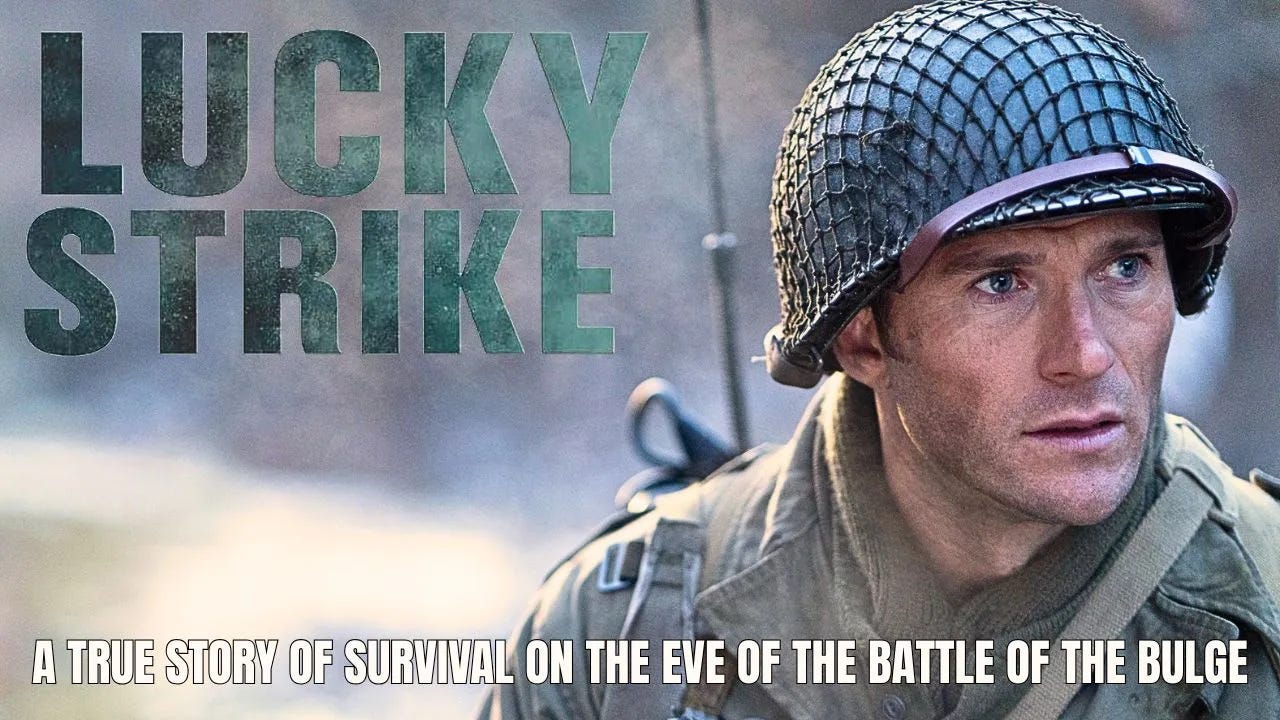
My Thoughts on Lucky Strike
A simple war film that knows its lane
Lucky Strike is certainly one of those films that makes its intentions clear pretty quickly, and then just sticks to them without second-guessing itself, where this war film is all locked onto one soldier, one situation, and one very controlled tone.
I did like the fact that it doesn’t clutter itself with side stories at first or try to constantly make it big for bigs sake, so by keeping everything so narrow, it all felt very focused and very easy to follow.
And while that narrow focus does works well for a bit, it does also make you notice that we don’t have much else going on underneath to focus on either, so while it’s a steady enough film, it doesn’t really grow into anything.
I do like simplicity sometimes in film, but it also means the said film will have its limitations, and here it does start to become a bit repetitive, as the film settles into this predictable cycle of movement, so when nothing really surprises the structure, you kind of know where it is going all the time.
But, I also wouldn’t call it completely boring either, as there are still some individual scenes that work, and when the film stops trying to overthink things and situations, it works decently enough to keep you semi interested.
The main issue though is while those moments work in isolation, they don’t actually build on each other in a way that changes any of the momentum, so they just sit side by side, hovering at the same level most of the time.
Watchable, but also meh.
Scott Eastwood
Scott Eastwood is basically left to hold this together for long stretches on his own, but I thought he was solid enough with what he was given, with a kind of exhausted focus that actually fits the tone and stripped-down style of the film.
When it works, it’s because he’s not trying to sell emotion in a big way, he’s just reacting and surviving, but there are also moments where you certainly feel the limits of what he’s given.
The character itself doesn’t really change much across the film, and the writing doesn’t really push him into different emotional spaces, so the performance just starts to feel like it’s circling the same ground over and over.
Colin Hanks and Aunjanue Ellis-Taylor also show up in smaller sections, and they’re fine, but they also feel more like framing devices.
The visuals stay consistent, maybe a bit too consistent
Visually, the film commits hard to a cold, drained look, sticking with it from start to finish, and I do think that consistency does again help the tone, where the camera also usually stays close enough to keep things clear enough.
We also get a few moments where the framing feels a little bit more deliberate, like the film briefly wants to step up its visual game, but doesn’t get quite manage to do what it wants to do, so once you’ve seen what it’s doing, you’ve basically seen all of it.
It’s not bad, just very fixed in place.
Dialogue that sometimes breaks the flow
The writing and dialogue itself is where I felt the most inconsistency, with some of it being perfectly serviceable, where it moves things along and keeps the story understandable, but the dialogue at times also sounds a bit too written, like it hasn’t fully settled into how people would actually talk in that situation.
It’s not constant, but it’s very noticeable when it happens, especially because the rest of the film is trying to stay so stable, so even slightly unnatural lines stand out more than they should.
But I did stay engaged throughout the film, and as said, I wasn’t too bored, but it worked more on a scene-by-scene basis rather than feeling like everything was building toward something bigger.
Final Verdict
I don’t think Lucky Strike is trying to be more than what it is, and I kind of respect that, with moments where the simplicity works fine, but it also doesn’t do much beyond the surface level.
I didn’t really hate it at any point, but I just didn’t come away with much either.
Trailer
Film Credits
Directed by Rod Davis Lurie
Written by Mark Frydman and Rod Davis Lurie
Cast Includes - Scott Eastwood, Colin Hanks, Aunjanue Ellis-Taylor and Taylor John Smith
Cinematography by Lorenzo Senatore
Edited by Christal Khatib
Music by Larry Groupé
Running time - 102 minutes
More Film Posts
Leviticus (2026) Review: Religion, Control, and Uneasy Relationships

If you’re looking for a lot of traditional horror elements with Leviticus, you might be disappointed, but if you like films that lean heavily on mood and tension, it’s worth watching.
Horror for the Hesistant

For anyone who wants to watch a horror film that isn’t a traditional jump scare horror, here are a few recommendations from me to you.
Marty Supreme Is a Wild Ride That Never Slows Down

You might need a lie down and a cup of coffee after watching Marty Supreme.
7 Movies I Watch When I Need a Mood Boost

Because sometimes all we relly need is to put on something funny, familiar, and guaranteed to leave us in a better mood.
Carolina Caroline Is a Watchable Film Held Together by Its Two Leads

If Samara Weaving is in a film, chances are I will watch it.
Ah, the war that created Israel.
I’m not interested in movies about the USA in WWII anymore unless it involves Americans dodging the draft. Now that, I’ll watch.