

Pressure starts off feeling like it might be fairly straightforward, then settles into something a bit more stubborn and oddly gripping.
Plot
In the tense 72 hours before D-Day, General Dwight D. Eisenhower and Captain James Stagg face an impossible choice - launch the most dangerous seaborne invasion in history or risk losing the war altogether.
Good Points
Andrew Scott gives a very controlled performance
Kerry Condon shines in the smaller moments
Tense despite the fact you already know how history plays out
Smart restraint
Pretty consistent tone that sticks to its approach, most of the time.
Bad Points
Brendan Fraser’s performance feels out of sync
Some conversations repeat similar arguments
Emotional beats are often understated
My Thoughts on Pressure
A Different angle on a familiar war setting
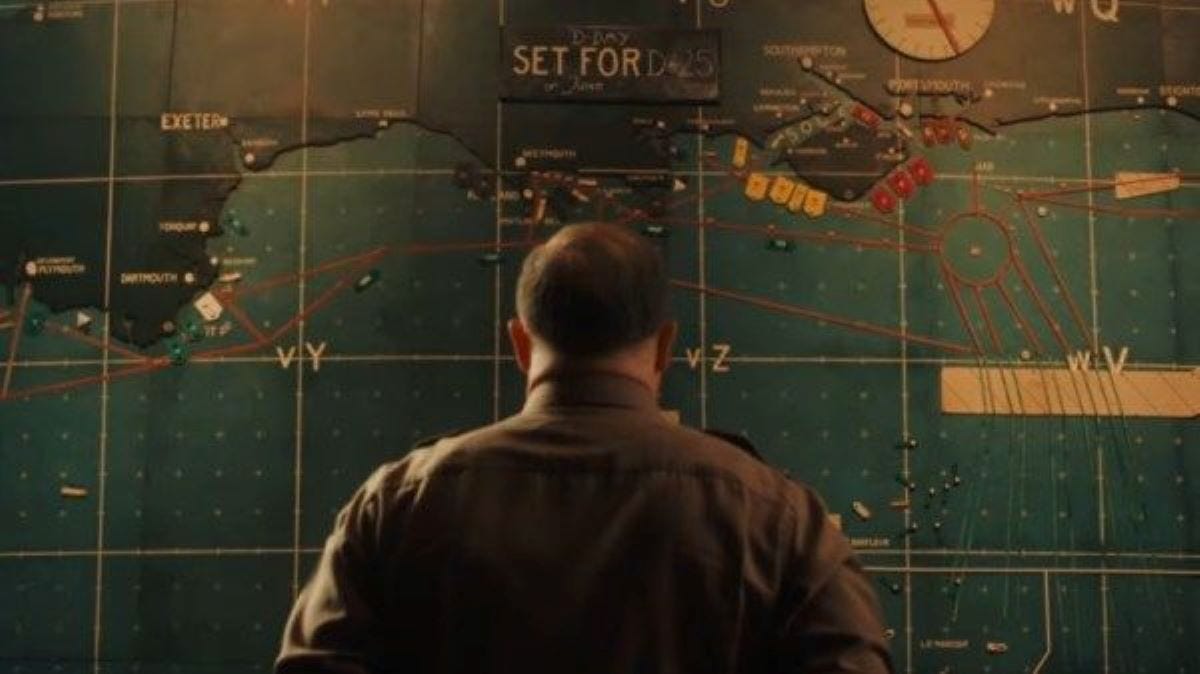
World War II stories usually land in one of two camps - either full battlefield scenes or neatly packaged hero moments with swelling music doing half the emotional work - Pressure though sits somewhere else entirely, as the film has little interest in showing the usual stuff, because here, everything hangs on decisions being made in rooms where people are arguing, second guessing, and trying to not to look like they’re guessing.
This could have all ended up very very dull, and we do get stretches where it really is just people talking under pressure, literally and otherwise, but there’s a strange momentum to it that keeps pulling you in and keeps you interested, because the film just commits fully to its own confidence that these conversations matter more than anything else going on in the world outside.
And annoyingly, it kind of proves itself right.

Andrew Scott
Andrew Scott quietly takes over the film without obviously trying to, with a steady performance that makes everyone else around him look like they’re slightly overdoing it, where he seems unbothered by the idea of big acting moments.
He stays controlled, almost frustratingly calm at times, but it’s that restraint that actually ends up doing more work than expected, even when the situation on screen is anything but calm, with a kind of slow pressure building in his performance that never explodes, just tightens bit by bit until you realize how much weight he’s carrying without saying it outright.
It also makes other performances stand out in sharper contrast, sometimes unfairly so, but that’s part of the experience here whether it was intended or not.
Brendan Fraser
While Brendan Fraser’s performance certainly doesn’t fail here, it also doesn’t sit comfortably alongside everyone else either, because he pushes everything up a level, sometimes several, where every decision feels urgent in a way that occasionally tips past the tone the rest of the film is working with, which creates this odd imbalance at times.
Scenes end up feeling slightly split, like two different acting styles are competing for attention in the same space, and while Fraser commits fully, no question about that, the approach doesn’t always land cleanly against the quieter performances surrounding him.
It’s certainly not disastrous, just a bit inconsistent in a way with the rhythm the film was trying to build.
Stress as entertainment
As mentioned above, this could have been boring, but there’s a strange thing the film pulls off where watching people disagree for long periods doesn’t become boring, it should, by normal rules of cinema survival, yet it doesn’t.
A lot of the scenes are built around conflicting opinions, delays, and people insisting they’re right with increasing confidence the less certain things become, which creates this low level tension that just keeps ticking along, and what really helped is that the film never really pauses to explain things for the audience’s benefit, as it assumes you’ll keep up, or at least get the general idea from context and tone.
That gives the conversations a slightly sharper edge, like you’ve walked into a room where everyone already disagrees and nobody wants to slow down and catch you up, and there’s also something mildly entertaining about how often people speak with total certainty while clearly operating on limited information - it’s not played for comedy, but there’s an irony sitting underneath it all.
There’s certainly a real confidence in the writing, even when the presentation feels a bit boxed in., but, every now and then, I did also find myself wishing the film would step outside those rooms a bit more just to break the pattern.
Kerry Condon and the smaller moments
Kerry Condon’s scenes ended up staying with me more than any I think, as what she brings to Pressure is a kind of clarity that cuts through the constant back and forth, and in a film full of competing voices, she feels like one of the few people actually reacting to the situation in a normal way.
Those moments matter too, because they reset the tone slightly, and without them, the film might have leaned too far into constant debate and lost any sense of reality, so she manages to keep it from drifting too far into pure discussion for the sake of discussion.
The final stretch without the big payoff energy
When everything builds toward its final stretch, the film resists the obvious temptation to turn into something louder or more dramatic, as there’s no sudden switch into spectacle, and no attempt to suddenly become a different kind of movie.
Part of me did respect that, but another part of me felt the restraint a bit too strongly, like the film was determined not to give me the kind of payoff modern storytelling usually trains you to expect, but what it does instead is stay consistent with its own approach, which is fair enough, even if it leaves the ending feeling more like a continuation of what came before rather than a distinct shift - it’s a quiet choice though, maybe too quiet depending on what you’re hoping for.
Final Verdict
Pressure ends up being one of those films that holds your attention in ways you don’t fully expect, even when you can see its limitations clearly, and I would say it is worth watching, just not for the reasons most war films usually are.
Trailer
Directed by Anthony Maras
Screenplay by David Haig and Anthony Maras
Based on Pressure by David Haig
Cast includes - Andrew Scott, Brendan Fraser, Kerry Condon, Chris Messina and Damian Lewis
Cinematography by Jamie D. Ramsay
Edited by Anthony Maras
Music by Volker Bertelmann
Running time - 100 minutes
Chopping Mall (1986) Review: So Bad It's Utterly Brilliant

If you’re wondering whether Chopping Mall is “good” in any traditional sense, the answer is absolutely not.
Chainsaw Man - The Movie: Reze Arc Review

If you want to watch a movie that has good action and some ridiculous violence, Chainsaw Man - The Movie: Reze Arc is worth a watch.
Backrooms (2026) Review: When Ambiguity Becomes the Scare

Backrooms wants you to sit in its psychological discomfort for as long as it does itself, which works really well for a while, until it decides to start explaining too much.
Is 'Undertone' Hiding Something Deeper?

I am sure a lot of you have all watched Undertone by now, a film that I liked, but has certainly got mixed reviews, and I completely understand why someone would not dig it!
Monkey’s Magic Merry Go Round Review: A Disturbing Children’s Show Turned Psychological Horror

Well, I wasn’t expecting a creepy kids show horror movie to become etched into my brain, but Monkey’s Magic Merry Go Round managed to do it.
Fraser’s performance just seems off. Tom Selleck was much better as Eisenhower in the TV movie Ike.