

I had a quiet suspicion before watching The Chronology of Water that this would either annoy me or stick around in my head longer than I wanted.
As it turns out, it managed to do both.
Good Points
Imogen Poots
The fragmented structure
Kristen Stewart commits hard to discomfort and doesn’t flinch
Humor slips in sideways, dry and unexpected
The refusal of a tidy resolution or emotional closure
Bad Points
Early sections are withholding to the point of irritation (Probably just a me thing)
Abstraction occasionally tips into indulgence
Pacing can feel stubborn
Demands patience without always rewarding it
This is not a film that meets you halfway
This film really makes it clear it is not interested in orienting you, as it moves in fragments, loops, and sudden shifts, guided more by memory than narrative sense, where scenes arrive without warning and leave you just as abruptly.
At first, I did actually find this frustrating, because the film seemed actively uninterested in helping me feel settled with the strong themes at play, but eventually, I stopped resisting that and let it do what it wanted, because I am nice like tat.
The opening stretch is especially demanding though, as dialogue is sparse, images do most of the work, and Lidia exists more as a texture than character.
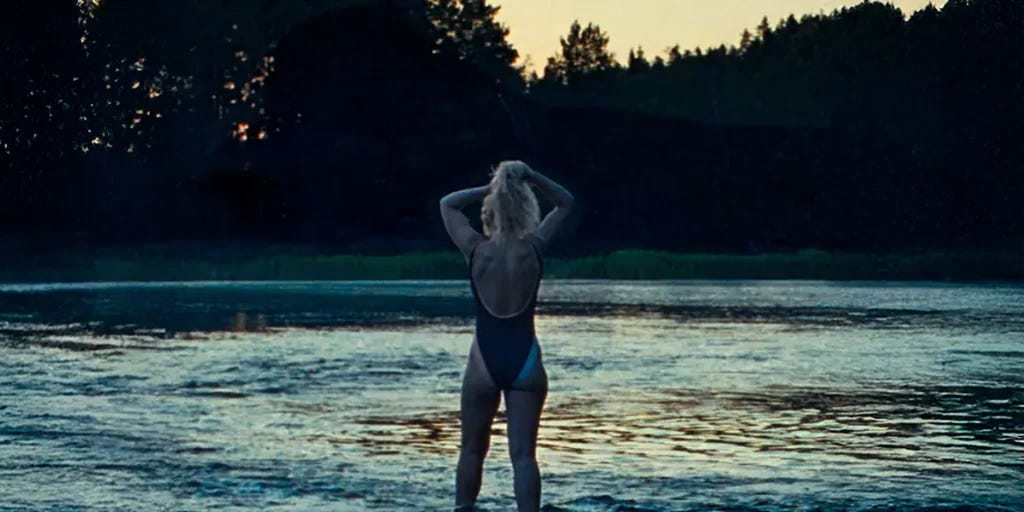
Hands, water, bodies in motion - and when her voice finally cuts through, it isn’t soothing or reflective, as it’s sharp, compressed, and impatient, like something that’s been waiting too long to speak.
And that tone never really softens.
Memory dictates the structure, not the other way around
As the film moves through Lidia’s life, it doesn’t track growth so much as accumulation, where college years bleed into chaos, relationships fracture, and destructive choices aren’t reframed or excused.
The film refuses flat out to tidy up her behavior, and I respected that, as these sections are uncomfortable, sometimes exhausting, and occasionally hard to watch, but it also makes the discomfort harder to ignore.
Imogen Poots carries nearly every frame though, and she does it without anu theatricality - she’s abrasive, funny, withdrawn, and oddly tender, sometimes within the same scene.
The film never asks you, and she exists as she is, unresolved and inconsistent.
Jim Belushi as Ken Kesey initially threw me however, and I won’t pretend it didn’t, but that skepticism faded quickly.
His presence is relaxed, offering humor and patience without becoming a corrective force, as he isn’t there to save Lidia or explain her, he just exists alongside her, which ends up being enough.
Kristen Stewart’s direction is wonderfully confident, and sometimes almost too confident, and shooting on 16mm helps give the film a tactile intimacy that suits its subject, but there are moments where visual flourishes push a little too hard I thought.
But none of it felt careless, and even the indulgence felt intentional.
Survival matters more than transformation here
Water runs through the film constantly, sometimes as refuge, sometimes as threat, and the symbolism is obvious, but not too heavy handed, as the film understands that the same thing can sustain you and undo you, often simultaneously.
By the end, there’s no resolution waiting, no lesson, and no emotional bow.
The Chronology of Water is more interested in endurance than healing.
Final Verdict
I liked it overall, but I didn’t love it.
I certainly respected it though.
It irritated me at times, held me at a distance, and refused to smooth itself out, but despite that, or maybe because of it, it did stay with me, so that’s something, too.
More Reviews


