

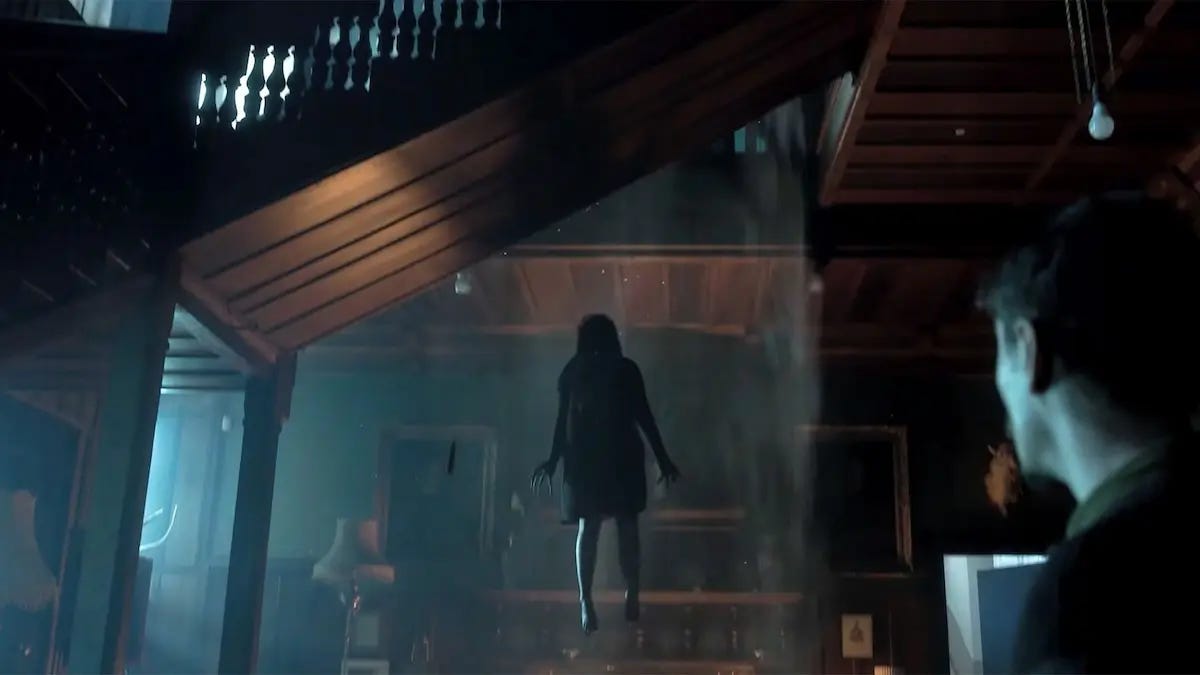
The Morrigan plunges you straight into a dark, shadowy world where Celtic mythology collides with some family drama, feminist tension, and folk horror tropes.
Synopsis
The Morrigan follows Fiona (Saffron Burrows), a successful but often absent archaeologist specializing in Gaelic mythology, who travels to a remote Irish island with her rebellious teenage daughter, Lily (Emily Flain).
Good Points
Emily Flain’s performance as Lily
Art Parkinson and James Cosmo provide some presence
The Settings
Bad Points
The male characters
Saffron Burrows performance underwhelms
Familiar horror tropes and clichés
Visuals are too dark at times
Female empowerment is muddled by repeated derogatory treatment
Pacing issues
The Morrigan as a frustrating but interesting hypnotic effect
I really enjoyed Emily Flain’s performance here, where her frustration is conveyed without exposition, while Art Parkinson as Lily is similarly restrained, with moments of tension or disruption filtered through the film’s stillness.
The island and inn are also good settings, where shots linger and movement is minimal, and where the environment dominates the frame, which helps to impose a quiet pressure that accumulates without overt threat.
The Morrigan herself is presented without much commentary, as her presence is sudden, and mostly external, where the film rarely explains motivation, focusing instead on the consequences of her emergence.
Repeated aggressions establish patterns rather than confrontation.
The first issue I had was the pacing, with long stretches of quiet or minimal activity which contrast with abrupt developments, especially around the supernatural elements, and the film alternates between observation and escalation, rarely resolving either entirely.
The Morrigan also leans heavily on familiar folk horror tropes, and it shows, where a lot of it feels recycled from films that came before it, and you will probably know where it’s going before the film tells you, where the dialogue also often tips into cliché.
But the biggest issue I had thought was the film’s attempts at female empowerment, where fiona and Lily are repeatedly subjected to derision and micro-aggressions from male characters, who are written more as interruptions, and this repetition undercuts the empowerment the story is gesturing toward.
Oh, and the film is dark, just too dark, which really doesn’t help the immersion you’re meant to be experiencing.
Final Verdict
The Morrigan is ambitious, awkward, and occasionally frustrating, and as a fan of folk horror films, this wasn’t one I was too impressed with for the most part.
It wears its influences openly, but rarely finds a way to make them land.
A bit too predictable and messy for my taste.
More Reviews


